When it comes to emergency medical services, understanding the right equipment is crucial. One common inquiry is, "What is the difference between a scoop stretcher and a backboard?" According to Dr. Emily Johnson, an emergency medical expert, "The choice between a scoop stretcher and a backboard can significantly impact patient safety during transport."
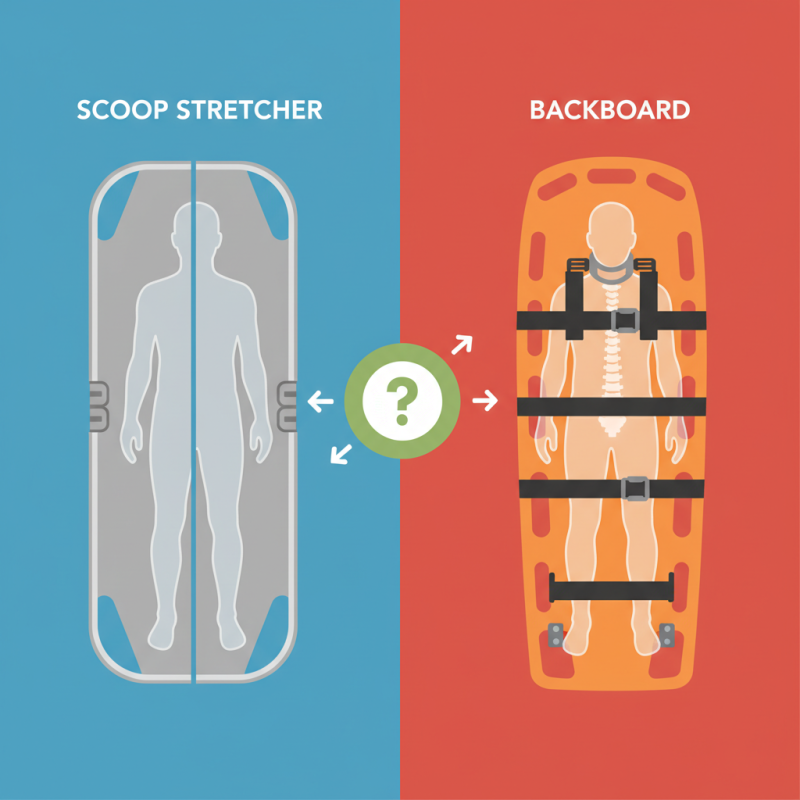
Both tools have unique designs suited for different situations. A scoop stretcher is split into two halves, allowing easy access to patients without moving them. This feature proves beneficial in avoiding further injury. In contrast, a backboard offers a rigid surface for spinal stabilization. Its strength ensures both safety and support while transporting patients with suspected spinal injuries.
Despite their clear purposes, confusion persists among novice responders. It’s essential to understand not just how to use these devices, but when to utilize each one effectively. Choosing the wrong tool in an emergency can lead to complications. Ensuring that all medical personnel are trained to discern these differences is vital. It not only emphasizes safety but also reflects the commitment to patient care in high-stress situations.
Key Features of Scoop Stretchers
When comparing scoop stretchers and backboards, it is crucial to understand the key features of scoop stretchers. They are designed for efficient patient transfers. Scoop stretchers consist of two separate pieces that can easily slide under an injured individual without unnecessary movement. This design is particularly beneficial in emergency situations.
The lightweight nature of scoop stretchers allows for easy handling. Emergency responders can carry them through tight spaces. Additionally, they often come with safety straps, keeping the patient securely in place during transport. However, the challenge arises when supporting spinal injuries. While they prevent rotation, they may not provide the same level of stability as backboards in certain scenarios.
Scoop stretchers also offer versatility. They can be used in various environments, making them ideal for outdoor or rugged settings. Despite their advantages, it’s important to reflect on their limitations. In situations involving severe spinal injuries, backboards may be the preferred choice. Each tool has specific strengths and weaknesses, making understanding them critical for effective rescue operations.
Key Features of Backboards
Backboards play a crucial role in emergency medical situations. These devices provide a stable surface for immobilizing patients. Designed for versatility, backboards can accommodate various types of injuries. Their rigid construction ensures that spinal movements are minimized during transport. Medical teams often use these boards to secure patients after trauma or accidents.
Key features of backboards include their lightweight design. This makes them easier to handle during emergencies. Some backboards come with straps to secure patients effectively. This added safety prevents further injury. Many models feature multiple carrying handles. These allow for better grip and maneuverability. The surfaces are often smooth, making it easy to clean.
However, there are challenges with using backboards. Ensuring proper patient alignment can be an issue. Misalignment may lead to discomfort or worsening of injuries. Additionally, some users may not be familiar with all features of a backboard. Training is vital to maximize effectiveness. It's important to recognize that while backboards are effective, they are not without their limitations.
Comparison of Use Cases for Scoop Stretchers and Backboards
When it comes to emergency medical responses, both scoop stretchers and backboards are essential tools. Each has unique features tailored for specific scenarios. According to industry reports, scoop stretchers are excellent for victims with suspected spinal injuries, allowing for quick and safe transfer. Their split design enables medical professionals to position the stretcher around the patient without moving them, which is crucial in minimizing further injury.
Backboards play a vital role in immobilizing and transporting patients efficiently. They provide stability during movement, which is particularly important for those with trauma. Data suggests that backboards are often preferred in scenarios requiring longer transportation times. They also serve multiple uses, such as supporting patients during treatment in the field.
**Tip:** Always assess the situation before choosing the appropriate device. Scoop stretchers are advantageous for rapid interventions, while backboards offer superior support during transport. Ensuring the right equipment can minimize complications and significantly impact patient outcomes.
**Tip:** Regular training on the correct use of both devices is essential for medical personnel. Familiarity with their strengths and weaknesses may enhance decision-making during emergencies. Proper use ensures that patient safety is the top priority.
Scoop Stretcher vs Backboard: Key Differences and Use Cases
| Feature |
Scoop Stretcher |
Backboard |
| Design |
Two-piece design that can be split into halves for easy access |
Solid, flat, and rigid board designed for spinal immobilization |
| Weight |
Generally lighter, making it easier to carry |
Heavier due to solid construction |
| Patient Access |
Allows for easier access to patients without moving them |
Requires lifting the patient onto the board |
| Use Case |
Ideal for situations where the patient cannot be moved easily, such as in confined spaces |
Best for fixed-location situations or in vehicles where securing is necessary |
| Cost |
Tends to be more cost-effective than backboards |
Can be more expensive due to material and design |
| Storage |
Easier to store due to its split design |
Requires more space for storage |
Advantages and Disadvantages of Each Option
When comparing scoop stretchers and backboards, it’s crucial to understand their advantages and disadvantages. Scoop stretchers are designed for easy access. Their split design allows rescuers to position and secure patients quickly. This is particularly useful in crowded or awkward spaces. However, they may not provide full spinal support during transport. This risk can be a concern for patients with suspected spinal injuries.
Backboards, on the other hand, offer more stability. They are rigid and provide a solid surface, which is vital for spinal immobilization. This feature is particularly important in trauma situations. Yet, backboards can be cumbersome. They are less convenient in tight spaces, and the process of applying and removing them takes longer. Additionally, long-term use can cause discomfort for the patient.
Choosing between these options requires careful consideration. The context of the injury often dictates the best tool. Some situations may call for speed, while others prioritize spinal safety. Go with what benefits the patient most, but be aware of each device's limitations.
Scoop Stretcher vs Backboard: Advantages and Disadvantages
Safety Considerations in Choosing Between Them
When deciding between a scoop stretcher and a backboard, safety is paramount. Both devices play critical roles in emergency medical situations but differ significantly in their application. The scoop stretcher is designed for quick retrieval of patients. It allows for easy access and minimizes further injury. However, issues can arise if used improperly. If not carefully positioned, it could lead to spinal misalignment.
On the other hand, backboards provide more rigid support. They are effective for immobilization during transport. However, they can pose risks if the patient is not secured correctly. Improper use may result in pressure points or discomfort. Medics need to assess each situation carefully. They must weigh the benefits and risks of each device to ensure the patient’s safety.
Medical professionals should always be trained in both methods. Continuous education and practice can improve confidence and effectiveness. Familiarity with each tool can lead to better decision-making in high-stress environments. Ultimately, it's about finding the right balance between speed and safety for the patient.
Conclusion
When examining "What is the difference between a scoop stretcher and a backboard?", it is essential to recognize their distinct features and use cases. Scoop stretchers are designed for easy patient loading and unloading, facilitating immobilization without the need for lifting the patient fully. In contrast, backboards provide a sturdy, flat surface for spinal stabilization and are commonly used in trauma situations.
The choice between these two options often depends on the specific circumstances of an injury. Scoop stretchers offer advantages in rapid scenarios where gentle handling is crucial, while backboards are ideal for spine immobilization and longer transport times. Each option has its own set of advantages and disadvantages, alongside safety considerations that should guide their use in medical emergencies. Understanding these factors ensures appropriate care and effective patient transfer during critical situations.

 Jones Medical