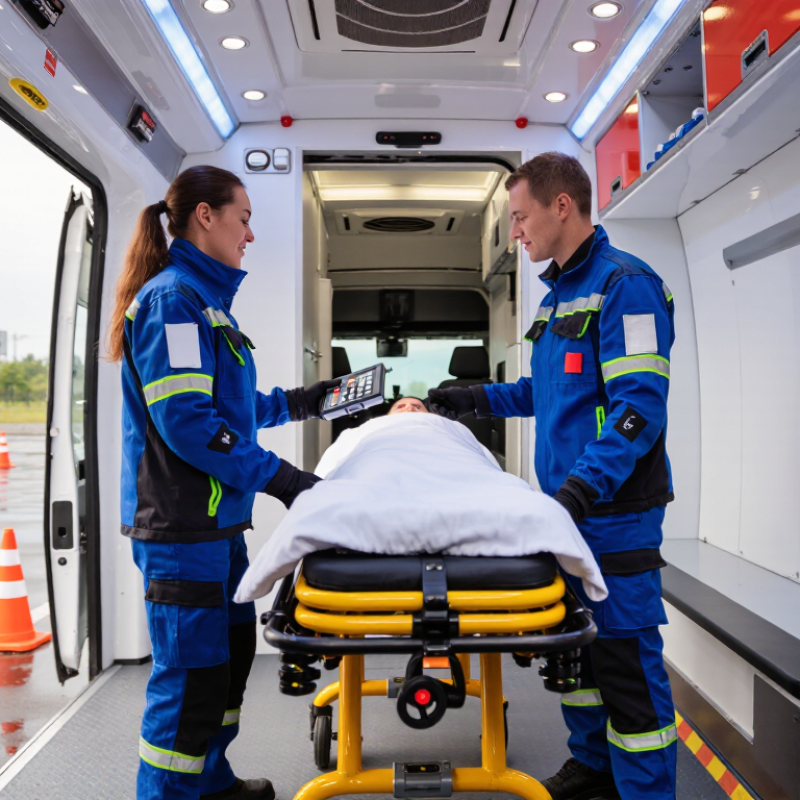
What are the benefits of electric stretchers for paramedics? This question matters during every transfer, especially inside crowded ambulances or narrow emergency departments. Electric stretchers can raise, lower, and adjust patient positions with powered controls. Paramedics may reduce repeated bending, pushing, and heavy manual lifting. That matters after long shifts, when small strains can become serious injuries.
Dr. Thomas R. Waters, a respected patient-handling researcher, has said, “The safest lift is the lift you do not perform.” His work supports reducing unnecessary manual handling through suitable equipment and trained teamwork. In practical use, a powered stretcher can lift a patient from ambulance height to a hospital bed more smoothly. It can also help one operator control height while another guides the patient. Less rushing. More control.
Leading Chinese electric stretcher manufacturers now focus on battery endurance, locking systems, corrosion-resistant frames, and emergency backup functions. These details matter beside wet roads, uneven ramps, and limited ambulance space. Yet electric assistance is not a complete solution. Batteries need inspection, wheels need cleaning, and crews still require transfer training. Some models may feel heavy or difficult on steep surfaces. That weakness deserves honest attention. The best stretcher is not simply the most advanced one. It must fit local ambulances, crew habits, patient needs, and reliable maintenance support.
A 318 kg load rating gives paramedics useful working capacity during demanding transfers. It supports the patient, mattress, monitor, oxygen equipment, and nearby accessories.
However, the rating should never replace a real patient assessment. Weight distribution matters. A concentrated load can challenge frame balance and wheel stability.
The stretcher architecture usually combines a reinforced platform, powered backrest, lifting columns, locking casters, and side rails. A 24 V power system supplies controlled movement through sealed motors and rechargeable batteries. This voltage supports practical lifting without relying on manual force alone. During loading, smooth height adjustment can reduce back strain and help align the stretcher with an ambulance deck.
In daily use, paramedics should inspect battery levels, rail locks, caster brakes, and emergency release functions. A short battery indicator is not enough evidence of readiness. Cold weather, repeated lifting, and heavy accessories may reduce operating time. That detail is easy to overlook. A stretcher may meet its rated capacity, yet still feel difficult to steer on ramps or uneven pavement. Training should include these conditions, not only clean indoor demonstrations. The 318 kg figure is valuable, but it describes capacity, not complete field performance.
Paramedic work often involves cramped rooms, wet floors, uneven paths, and urgent decisions. Manual lifting can turn a routine transfer into a back injury. Powered lifting changes the physical demand by raising the patient with controlled motor assistance. It reduces the need for repeated bending, pulling, and sudden force from one rescuer.
The UK Health and Safety Executive estimated 511,000 workers experienced work-related musculoskeletal disorders in 2023/24. These conditions caused about 7.8 million lost working days. The figures cover all industries, but they reflect a familiar ambulance problem: repeated handling creates cumulative strain. EU-OSHA also reported that three in five European workers experienced musculoskeletal symptoms in its workplace survey. Small injuries can build quietly.
Powered stretchers help most when crews use them correctly. One operator can adjust height before loading, reducing awkward waist-level lifting. The ambulance loading step also becomes more controlled. That matters on narrow streets and sloped driveways. Powered does not mean effortless. Crews still need patient assessment, wheel control, secure positioning, and clear communication.
A hurried transfer still exposes weaknesses. Batteries may be low, surfaces may be uneven, and training may become inconsistent. A 2021 NIOSH safe patient handling review stresses that equipment works best with training, adequate staffing, and a complete handling program. The strongest choice is not the heaviest stretcher. It is a system that fits real callouts, crew strength, patient weight, and local maintenance capacity. Some manual handling remains unavoidable. The goal is to reduce its frequency and intensity.
For paramedics, an electric stretcher should be judged by workflow, not showroom features. Battery cycles matter during long shifts, especially when crews complete repeated lifts, transfers, and ambulance loading. A dependable unit should support a full shift without emergency charging. NIOSH identifies patient handling as a major musculoskeletal risk in emergency care. The 2023 U.S. Bureau of Labor Statistics report recorded 275,540 days-away-from-work cases in healthcare and social assistance. Reducing manual lifting can therefore protect staff and preserve operational capacity.
Lift speed directly affects loading time, but faster is not always safer. A controlled lift helps paramedics align the stretcher with the ambulance deck, avoiding sudden movement near the patient’s head. Even a 20-second saving per loading cycle can recover several minutes across a busy shift. That difference becomes visible when crews face narrow bays, rain, or heavy protective equipment. Field evaluations should measure complete loading time, not only motor speed. Include approach, height adjustment, locking, and confirmation.
Battery testing needs practical discipline. Record cycles under real patient loads, cold-weather conditions, and partial-charge use. Manufacturer claims may reflect ideal laboratory settings. They can disappoint in service. Track charging interruptions, warning alarms, and manual backup frequency for at least 30 days. The 2022 National EMS Assessment from NHTSA shows how varied EMS operating environments can be, so one battery result cannot fit every service. A useful procurement trial should compare cycle capacity, lift consistency, and ambulance turnaround time together.
Electric stretchers can reduce lifting demands during ambulance loading. That matters when crews work in narrow spaces, poor weather, or repeated transfers. The World Health Organization’s Global Status Report on Road Safety 2023 records about 1.19 million road deaths each year. Many patients arrive with spinal, limb, or chest injuries. Their restraints must remain secure during movement, braking, and cornering.
EN 1865-2 focuses on power-assisted stretcher performance and safe handling. A compliant design should support controlled movement, stable locking, and suitable patient restraint arrangements. The chest, pelvic, and leg straps should fit without pressing injured areas. They should also remain adjustable with gloves. Small details matter. A loose buckle can become a serious problem. Paramedics should inspect straps, anchor points, and locking indicators before every call.
EN 1789 addresses road ambulance design and equipment integration. An electric stretcher must match the ambulance’s loading system, floor fixation, available clearance, and working height. Certification alone does not prove compatibility with every vehicle. Procurement teams should review test evidence, installation instructions, maintenance records, and user training. The WHO’s 2023 report also highlights post-crash care as a key part of road safety. Faster loading may help, but speed should never replace restraint checks. Some product claims still need independent verification. That is an uncomfortable, but necessary, point.
China Top Electric Stretchers Benefits for Paramedics?
For paramedics, an electric stretcher should reduce lifting strain without creating handling problems. Weight is a key procurement metric. A lighter frame can improve stairway movement and ambulance loading. However, an extremely light stretcher may feel less stable with heavier patients. Buyers should compare total operating weight, battery weight, and safe working load. Test the stretcher with real crew members, not only catalog figures.
The IP rating shows how well the electrical system resists dust and water. A higher rating can support outdoor transfers, wet roads, and frequent cleaning. Still, IP protection is not a substitute for correct maintenance.
Braking performance deserves a practical assessment. Check stopping distance, wheel grip, brake access, and stability on ramps. A stretcher that rolls slightly during loading can increase risk quickly. Ask for test records and inspect performance under a realistic patient load.
Tips: Request a service-life estimate based on daily cycles, not ideal laboratory use. Review battery replacement intervals, actuator testing, frame fatigue checks, and spare-part availability. Inspect hinges and casters after repeated use. Small failures become expensive delays. One imperfect assumption is common: buyers often treat service life as a fixed number. It depends on cleaning methods, crew habits, floor surfaces, and maintenance quality. A transparent supplier should explain these limits and provide written support procedures.
Repeated lifting, transfers, and ambulance loading can drain power quickly. A full-shift battery reduces emergency charging interruptions.
Test cycles with realistic patient loads, cold temperatures, and partial charging. Track alarms and manual backup use for at least 30 days.
No. Speed is not everything. A controlled lift helps align the stretcher with the ambulance deck safely.
Measure approach, height adjustment, locking, and confirmation. Motor speed alone gives an incomplete picture.
Saving 20 seconds per loading cycle may recover several minutes across a shift. The benefit becomes clearer in rain or narrow ambulance bays.
Chest, pelvic, and leg straps should stay secure during braking and cornering. They should adjust easily while crews wear gloves.
Check straps, anchor points, buckles, and locking indicators. A loose buckle can create serious risk.
No. The stretcher must match the vehicle’s loading system, floor fixation, clearance, and working height. Certification alone is not enough.
Review testing records, installation instructions, maintenance history, and user-training materials. Some performance claims still need independent verification.
What are the benefits of electric stretchers for paramedics? Electric stretchers can improve emergency transport by combining powered lifting, controlled movement, and strong structural support. Models with load ratings of up to 318 kg and 24 V power systems can accommodate a wide range of patients while supporting dependable operation. Powered height adjustment reduces the need for paramedics to lift manually, helping limit back strain, fatigue, and handling injuries during repeated transfers.
Operational performance also matters. Battery cycle capacity, lifting speed, and ambulance loading time influence how efficiently crews can respond between calls. Patient protection depends on secure restraints designed to meet EN 1865-2 requirements and compatibility with ambulance layouts under EN 1789. During procurement, teams should compare stretcher weight, ingress protection rating, braking performance, service life, charging arrangements, and maintenance support. Evaluating these factors together helps emergency services select equipment that balances patient safety, crew ergonomics, reliability, and long-term operating value.

Jones Medical